Leave Your Phone Behind: Unlocking Your Door with an Apple Watch in 2026
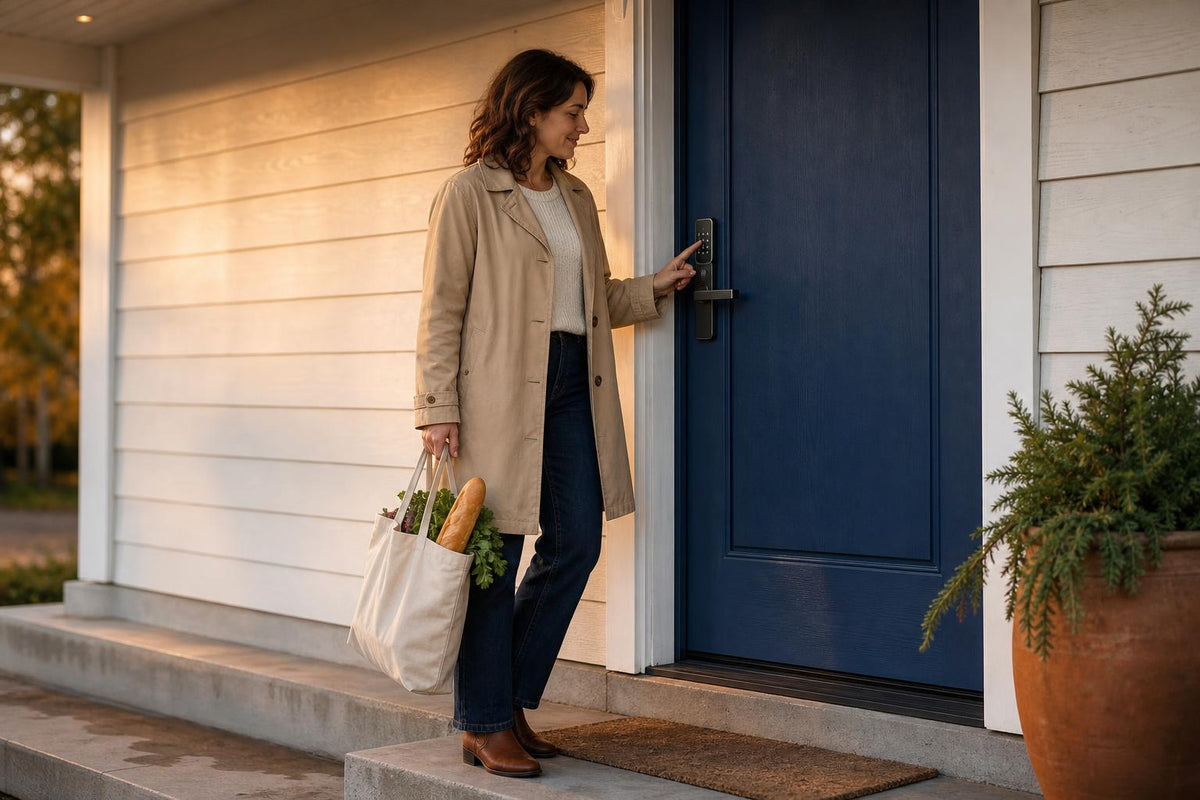
Picture this: It's 2026. You're walking home, both arms loaded with groceries. As you approach your front door, you hear a soft click. The door unlocks for you automatically, without you ever breaking your stride. You don't need to find your keys, pull out your phone, or even tap your wrist.
This isn't science fiction; it's the near future of apple watch smart lock entry. Thanks to the growing maturity of Ultra-Wideband (UWB) technology and Apple's deepening smart home ecosystem, the way we enter our homes is evolving. It's moving from a simple tap to a truly hands-free, automated experience.
This guide will dive into the technology making this possible, the gear you'll need, and how this shift will redefine convenience in our daily lives. Get ready to leave your phone in your pocket—for good.
The 2026 Leap: From Tapping with NFC to True Hands-Free Entry with UWB
The key difference between today's smart lock experience and the one awaiting us in 2026 comes down to two acronyms: NFC and UWB. Currently, Apple's Home Key feature uses Near Field Communication (NFC), the same tech behind Apple Pay. You tap your watch to the lock, and it opens—convenient, but it still requires a deliberate action.
Ultra-Wideband (UWB) technology is the real engine for wearable keyless entry. Unlike NFC, UWB provides precise spatial awareness. It doesn't just know your watch is near the lock; it knows its exact location, distance, and direction of approach. This is what enables a "walk-up and unlock" experience without any physical interaction.
This isn't just a concept—lock manufacturers are already implementing it. For instance, some UWB-enabled locks can already perform this "approach and unlock" function. The system is smart enough to be intentional; it will only unlock when it detects you approaching from the outside, preventing accidental unlocking while you're moving around inside your house.
How UWB Spatial Awareness Makes Your Approach Intentional
Think of Bluetooth or WiFi as a general broadcast; they know you're in the room. UWB, however, works like a precise radar system. By measuring the "time of flight" of radio signals between your watch and the lock, it can calculate your exact position with centimeter-level accuracy.
This precision allows the system to differentiate between someone walking past the house on the sidewalk and the homeowner walking directly toward the door. It analyzes your trajectory and intent, ensuring the door only unlocks when you mean for it to. This level of accuracy is what makes hands-free entry both possible and secure.
Built-in Safety: Accidental Unlock Protection on Your Wrist
Automation is great, but control is essential. What if something goes wrong? When your door unlocks automatically via UWB, you'll receive an immediate notification on your Apple Watch.
This alert gives you a simple, one-tap option to "Relock" the door instantly. It's a simple but powerful safety net, giving you final say and complete peace of mind over your home's security.
Gearing Up for 2026: Your Checklist for an Apple Watch Smart Lock System
Ready to embrace a keyless future? To get the full hands-free experience in 2026, you'll need a specific set of hardware and software. While some current devices are already compatible, the most seamless systems will likely rely on the latest tech.
The core requirement is UWB support. This technology is built into newer Apple devices and is essential for the spatial awareness needed for automatic unlocking. While we anticipate the Apple Watch Series 12 and watchOS 13 will bring further software refinements, the hardware foundation is already here.
The Essential Hardware: Which Watch, Phone, and Lock Do You Need?
To build your hands-free entry system, here’s what you’ll need to have on your shopping list:
- Apple Watch: A Series 6 or newer, including all Ultra models. These models contain the U1 chip for UWB.
- iPhone: An iPhone 11 or newer. Your phone works with your watch to set up and manage the digital key.
- Smart Lock: A lock that explicitly supports "Apple Home Key with UWB." This is a key feature to look for on the product's packaging and specifications.
The emergence of new standards like Aliro may also broaden your choices, bringing Home Key-like features to more brands. When choosing a lock, consider options like the SAWHERO SentriKey Smart Lock, which offers a robust foundation with multiple entry methods and detailed security logs, serving as a reliable counterpart to your high-tech Apple ecosystem.
Smart Lock Decision Matrix: NFC vs. UWB vs. WiFi-Direct Locks
Choosing the right smart lock for your apple watch smart lock entry plan can be confusing. Each technology offers a different balance of convenience, control, and compatibility. Use this decision matrix to find the best fit for your lifestyle.
| Feature | NFC (Apple Home Key) | UWB (Advanced Home Key) | WiFi-Direct (App-Based) |
|---|---|---|---|
| How It Works | Tap your watch or phone on the lock to open. | Walk into the detection zone and the door unlocks automatically. | Open a smartphone app to unlock remotely or locally. |
| Core Advantage | Fast, intuitive, and very low power consumption. | Ultimate convenience, truly hands-free entry. | No smart home hub needed, flexible remote control. |
| Device Dependency | Compatible Apple devices and lock required. | Requires UWB-chipped Apple devices and a UWB lock. | Requires only a smartphone and the lock itself. |
| Best For | Users who want quick, tap-and-go access without fumbling for a phone. | Users who often have their hands full (parents, shoppers, etc.). | Users needing frequent remote access (vacation rentals, guest entry). |
| Potential Drawback | Requires physical contact or getting very close to the lock. | Newer tech; fewer and more expensive lock options currently. | Requires opening an app, which can be slow; relies on home WiFi. |
Beyond Entry: How Your Watch Commands a Smarter Home in 2026
Unlocking your door is just the beginning. By 2026, your Apple Watch will be at the center of a much smarter, more proactive home. The focus is shifting from you giving commands to your home anticipating your needs, driven by advancements like "Apple Intelligence" and a more capable Siri.
Imagine a scenario powered by this new ecosystem. As your watch detects you're a block from home, it doesn't just prepare to unlock the door. It triggers your "Arrival" scene: the thermostat adjusts to your preferred temperature, hallway lights turn on, and your favorite "welcome home" playlist begins to play. Your watch becomes the ultimate presence sensor.
Predictive Automations: When Your Home Knows You're Arriving
Predictive automation means your smart home learns from your routines. Instead of you manually building complex rules, the system will notice patterns and suggest helpful automations. For example, it might ask, "I see you usually turn on the kitchen lights after arriving. Would you like me to add that to your Arrival scene?"
Your Apple Watch is the key to this, providing the personal, on-body presence detection needed to make these automations feel truly intelligent and personal. It tells your home not just that someone is home, but that *you* are home.
The Rumored "HomePad": A Central Hub for Your Connected Life
To coordinate this complex dance of devices, rumors suggest Apple may release a dedicated smart home hub by 2026, sometimes referred to as a "HomePad." According to reports from sources like Macworld, this could serve as a central command center for your home.
This hub would work seamlessly with your Apple Watch, creating a faster and more reliable network for all your devices. No matter how smart the controls get, remember that a reliable hardware foundation is crucial. If you ever run into issues, having a clear resource like a Help Center is essential for troubleshooting your core devices.
Answering Your Top Questions about Unlocking Doors with Apple Watch
Adopting new home technology always comes with questions. Here are answers to some of the most common queries we see in communities on Reddit and other forums about using an Apple Watch as your house key.
- Q1: Will my current Apple Watch work with these new 2026 features?
- A: Not for everything. While current models with NFC support the "tap-to-unlock" Home Key, the true hands-free UWB feature requires an Apple Watch Series 6 or newer. For the most refined experience, we expect the unannounced Apple Watch Series 12 in 2026 will be the top performer.
- Q2: What happens if my Apple Watch battery dies? Am I locked out?
- A: No, you're never truly locked out. Smart locks always provide multiple backup methods. Most, like those from SAWHERO, come with physical keys, a keypad for codes, and often a Type-C port for emergency power from a power bank. Your iPhone also serves as a digital backup key.
- Q3: Is UWB hands-free unlocking secure? Could someone unlock my door from the street?
- A: It is designed to be highly secure. UWB's precision is its greatest strength. The system can tell the difference between you standing right at the threshold versus being a few feet away on the porch, ensuring it only unlocks upon an intentional approach from outside.
- Q4: I've read about Apple Home Key problems on Reddit. Will UWB be more reliable?
- A: While some users have reported occasional NFC connectivity issues, UWB is generally a more robust and precise technology. As Apple further integrates it into the OS and pairs it with dedicated hubs, reliability is expected to improve significantly over current NFC implementations.
- Q5: Do I need an Apple HomePod or Apple TV to make this work?
- A: Yes, for remote access and automations with the current Home Key, a Home Hub like a HomePod or Apple TV is required. For the advanced UWB features and deeper home integration expected by 2026, a central hub will likely be essential for best performance.
- Q6: Will this technology work for apartment buildings or renters?
- A: Absolutely. Many modern smart locks are designed for simple, no-drill installation on standard doors, making them ideal for renters. Features like temporary digital keys are also perfect for granting access to landlords or maintenance staff. Check out brands that cater to these needs on sites like sawherodoorlock.com.
The Verdict: Is Wearable Keyless Entry the Future for Your Home?
By 2026, apple watch smart lock entry will have evolved from a neat tech trick into a cornerstone of the automated home. The jump from NFC's tap-to-enter to UWB's walk-up-and-unlock represents a massive leap in convenience that's hard to overstate.
This seamless experience is tailor-made for anyone seeking an efficient, frictionless lifestyle—busy parents, tech enthusiasts, or anyone tired of juggling keys. It transforms the simple act of entering your home into a smooth, welcoming experience.
If you're planning your next smart home upgrade, now is the time to start looking for devices that support UWB. The future of wearable keyless entry is almost here, and it's ready to make your life just a little bit easier.