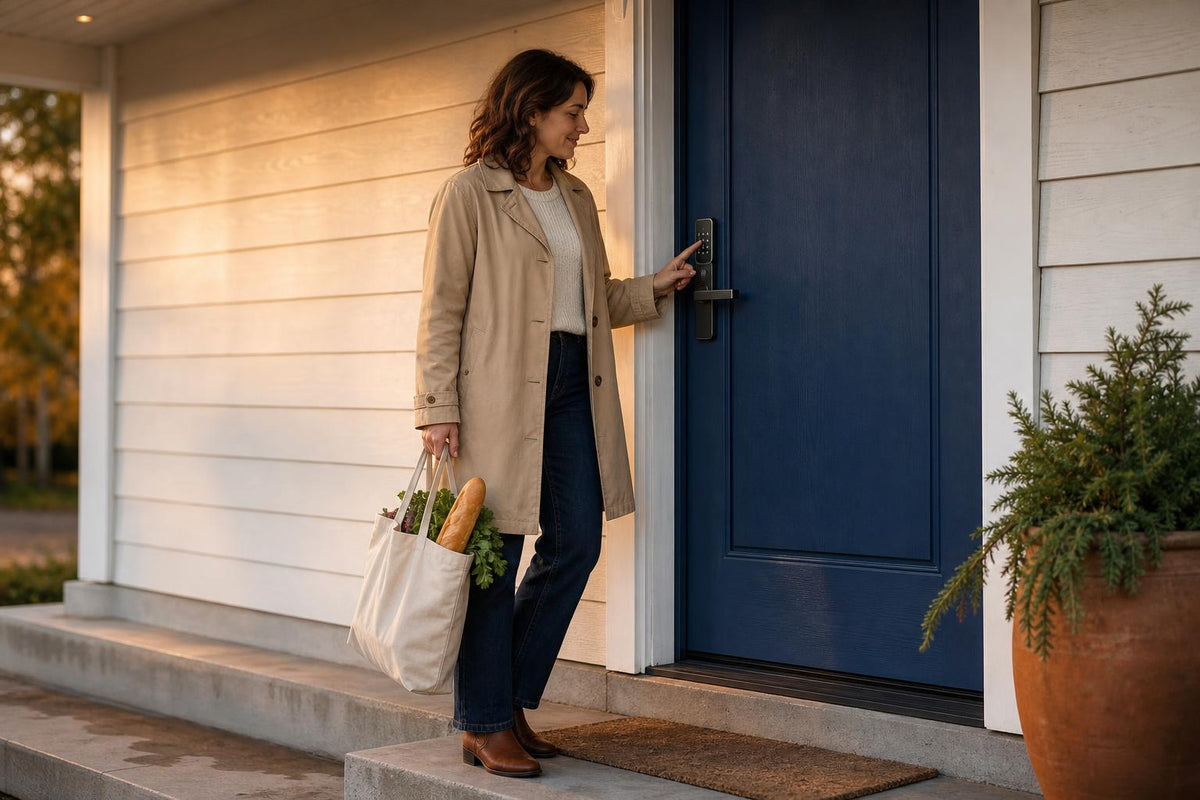
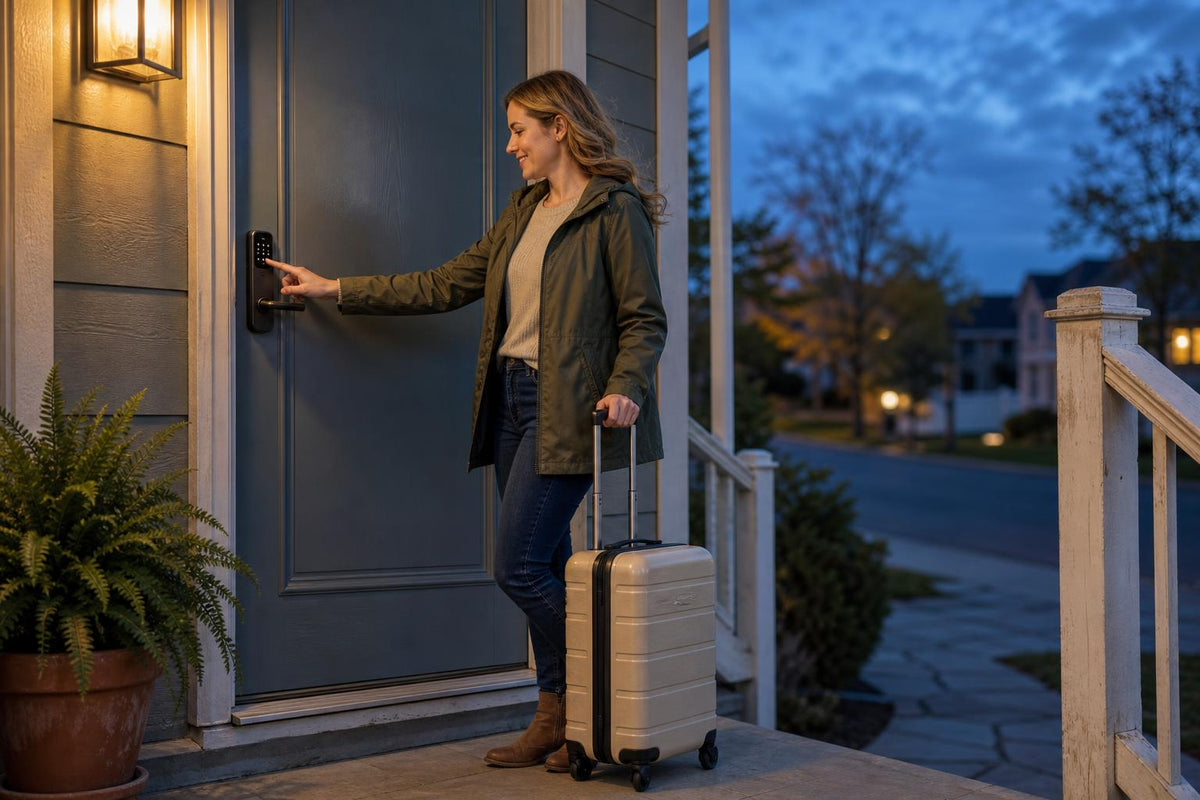
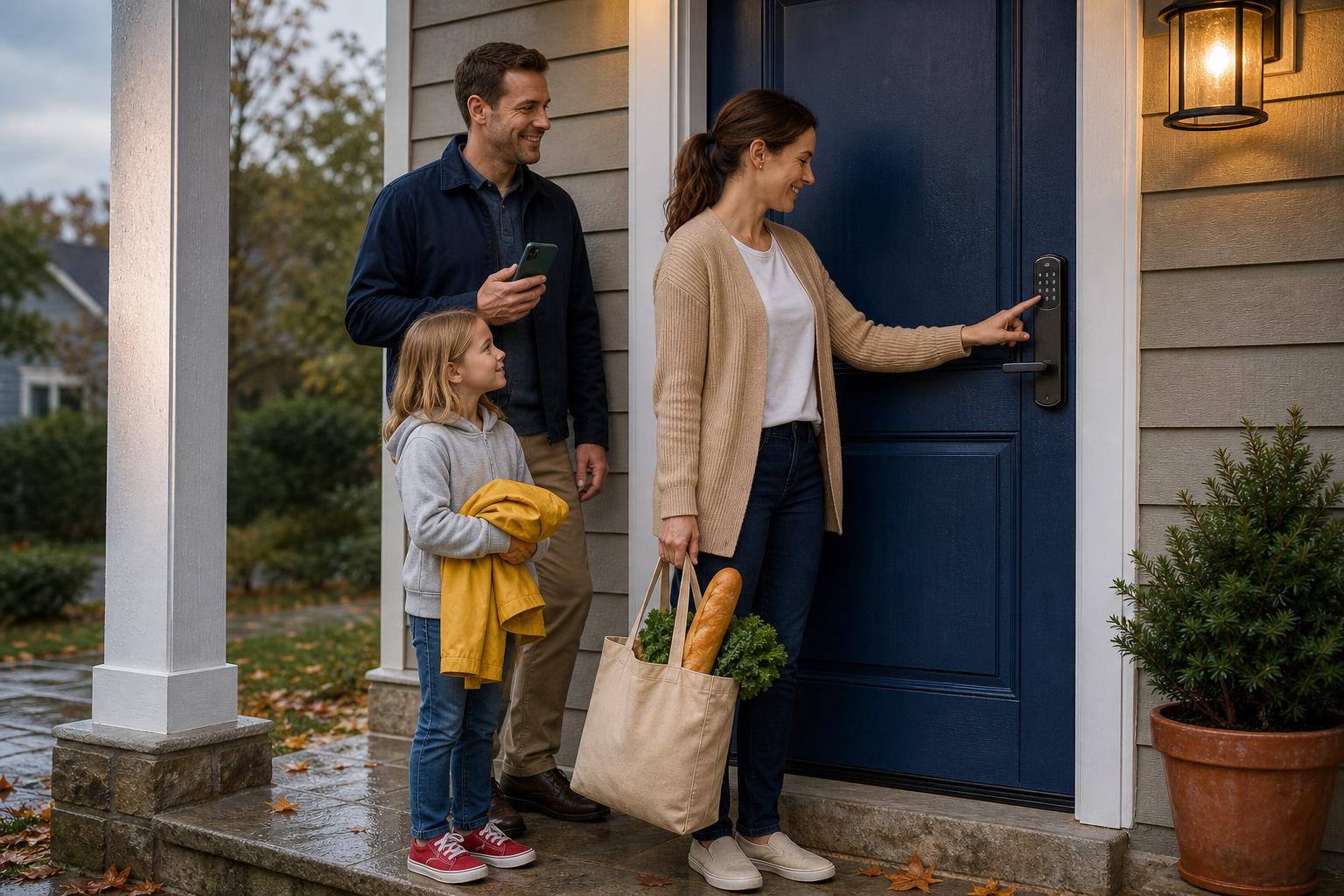
Picture this: you're juggling a week's worth of groceries, the dog's leash is tangled around your arm, and it's starting to rain. The last thing you want to do is fumble for keys. This daily struggle is at the heart of the facial recognition vs. fingerprint smart lock 2026 debate, and it's the central question for anyone looking to upgrade their home security.
The choice is no longer just about ditching physical keys; it’s about which biometric technology best fits your life. This guide won't declare a single winner in the facial recognition vs. fingerprint smart lock 2026 showdown. Instead, through a detailed comparison, we'll help you decide which lock—the one that sees you or the one that knows your touch—is the perfect gatekeeper for your home.
The Core Technologies: How Do They Actually Work?
Before you choose, it helps to understand what’s happening behind the scenes. Both technologies are far more sophisticated than the scanners on early smartphones. They're built with security as the top priority, using complex methods to ensure the person at your door is actually you—a key factor in the facial recognition vs. fingerprint smart lock 2026 debate.
Facial Recognition: More Than Just a Camera
Modern face ID door locks don't just take a picture. They use advanced 3D structured light or infrared sensors to create a detailed depth map of your face, capturing thousands of unique data points. It's the same technology that secures your smartphone.
They also employ "Liveness Detection" to prevent spoofing. These algorithms analyze subtle cues like blinking to confirm it's a real, three-dimensional person, not a photograph or video. Leading manufacturers claim to have driven the False Acceptance Rate (FAR) down to less than one in a million, making it incredibly secure.
Fingerprint Scanning: The Trusted & Tested Method
Fingerprint scanning is the veteran of biometrics—a reliable and proven technology. Most smart locks use capacitive sensors, which use your skin's electrical properties to map the unique ridges and valleys of your fingerprint with high precision. Other types include optical sensors, which take a high-resolution image, and ultrasonic sensors that use sound waves for a 3D map, offering top-tier security.
Its widespread adoption speaks to its dependability. In 2019, fingerprint identification accounted for 92% of methods in China's massive smart door lock market, showing just how deeply established this technology is and providing a strong baseline for the facial recognition vs. fingerprint smart lock 2026 comparison.
Real-World Scenarios: Where Each Technology Wins (and Fails)
But specs on paper don't tell the whole story. The true test in the facial recognition vs. fingerprint smart lock 2026 debate happens in the messy, unpredictable moments of daily life. How a lock performs with a child, in a rainstorm, or when the power goes out is what truly matters.
The Family Home: Kids, Elderly, and Multiple Users
For families, ease of use across different ages is critical. Facial recognition often wins here, as it requires no specific action from the user. This is a huge benefit for children who might forget a code or for anyone whose hands are full.
Fingerprint sensors can sometimes be a challenge for children with smaller, less-defined prints or for elderly individuals with worn or dry skin. However, many high-capacity fingerprint locks can store 100+ prints, making them ideal for large families or rental properties. Advanced systems like the SAWHERO SentriKey tackle this with multi-angle recording to significantly boost recognition rates for all users.
Environmental Challenges: Rain, Sunlight, and Dirty Hands
Your front door is exposed to the elements, and this is where each technology can falter. Fingerprint sensors are notorious for failing when fingers are wet from rain, oily, or dirty from yard work. Facial recognition is completely immune to these issues.
Conversely, strong, direct sunlight or heavy backlighting can sometimes interfere with facial recognition cameras, causing a failed scan. Fingerprint sensors are unaffected by light conditions. The bottom line in this part of the facial recognition vs. fingerprint smart lock 2026 analysis is to consider your home's specific environment.
Backup and Failsafes: When Biometrics Don't Work
No technology is perfect. That's why having robust backup options is non-negotiable. Both types of locks typically run on AA batteries for months and provide low-battery warnings. For total emergencies, they should offer a mechanical key and a USB-C emergency power port.
This is where a hybrid approach shines. A lock that combines biometrics with a PIN code, app access, and a physical key offers the ultimate peace of mind. It ensures that no matter the situation—a dead battery, a failed scan, or a forgotten phone—you are never locked out. This is a core principle behind SAWHERO's robust 6-in-1 design.
Decision Matrix: Facial Recognition vs. Fingerprint Smart Lock in 2026
So, let's break it down. To help you make a clear choice in the facial recognition vs. fingerprint smart lock 2026 debate, here’s a direct comparison of how these two biometric technologies stack up in the areas that matter most.
| Feature / Scenario | Facial Recognition Smart Lock | Fingerprint Smart Lock | Winner / Best For... |
|---|---|---|---|
| Convenience | ⭐⭐⭐⭐⭐ (Completely hands-free, unlocks even when carrying items) | ⭐⭐⭐⭐ (Requires a touch, but still faster than keys) | Facial Recognition: Users seeking the ultimate convenience. |
| Reliability | ⭐⭐⭐⭐ (Can be affected by strong backlighting or direct sunlight) | ⭐⭐⭐⭐ (Can fail with wet, dirty, or dry fingers) | Tie: Both have limitations in specific conditions. |
| Speed | ~0.5-1 second | As fast as 0.2 seconds | Fingerprint: Users who prioritize raw unlock speed. |
| Security | ⭐⭐⭐⭐⭐ (3D liveness detection is extremely hard to spoof) | ⭐⭐⭐⭐ (High-security sensors are mature and reliable) | Facial Recognition: Users prioritizing cutting-edge security tech. |
| User Scenarios | Busy families, people who often carry things, tech enthusiasts. | The vast majority of households, budget-conscious users, those who value consistency. | Depends on Lifestyle |
| Cost (2026) | Higher (Premium) | More Affordable (Mainstream) | Fingerprint: Budget-sensitive buyers. |
| Future-Proofing | ⭐⭐⭐⭐⭐ (Rapidly growing market, represents the future trend) | ⭐⭐⭐ (Mature technology, growth is stabilizing) | Facial Recognition: Users investing in future-proof tech. |
Top Brands & Market Trends: What's Next for Smart Locks?
The smart lock landscape is buzzing with innovation. Established brands and new players are pushing the boundaries of what home access can be, and market data shows a clear trend towards smarter, more integrated biometric solutions as the facial recognition vs. fingerprint smart lock 2026 market evolves.
Leading the Pack: Eufy, Lockly, Yale & More
A brief brand comparison shows a healthy, competitive market. Tech publications like PCMag have praised the Lockly Visage Zeno, which cleverly integrates both technologies and supports Apple Home Keys. Yale's Luna Pro+ uses high-security 3D structured light for its facial scanning, while Eufy is known for its fast biometric readers and robust encryption.
Even retrofitting is an option. SwitchBot offers an innovative solution that adds 3D facial recognition to your existing deadbolt, proving that you don't necessarily need to replace your entire lock to get the latest tech.
The Future is Hybrid (and Smarter)
Looking at smart lock market trends for 2026, the direction is clear. The global market is projected to hit $8.1 billion according to Grand View Research, with the biometric segment growing at an impressive compound annual growth rate of over 20%. This growth is fueled by a simple truth: the best solution isn't one or the other, but a combination.
A hybrid lock that combines multiple unlock methods is the ultimate answer. A device like the ultimate 6-in-1 smart lock, which offers fingerprint, passcodes, an app, and a physical key, provides a comprehensive safety net. It ensures you can always get in, resolving the toughest parts of the facial recognition vs. fingerprint smart lock 2026 dilemma.
FAQ: Your Biometric Smart Lock Questions Answered
Making the leap to a new technology can come with questions. Here are direct answers to some of the most common concerns about the facial recognition vs. fingerprint smart lock 2026 decision.
How accurate are facial recognition smart locks in 2026?
They are extremely accurate. Thanks to 3D sensors and liveness detection, the false acceptance rate is below one in a million, which is statistically far more reliable than a person's ability to recognize a face.
What happens if the power or Wi-Fi goes out?
Core functions like fingerprint and passcode access are stored locally on the lock itself, so they work reliably without power or internet. Most locks run on standard AA batteries for 6-8 months and feature backup options like a Type-C emergency power port and traditional mechanical keys. For more details, you can visit our help center.
Can someone use a photo of me to unlock my door?
No. Modern facial recognition locks use 3D depth-sensing and liveness detection. They can easily distinguish between a flat 2D image or video and the complex contours of a real human face.
Is it difficult to install and set up a biometric smart lock?
Not anymore. Many brands, including the SAWHERO SentriKey, are designed for easy DIY installation in under 10 minutes with just a screwdriver. Setup is guided by a simple app, and you can always check our help center for tutorials if you get stuck.
Do these locks work in the dark?
Yes. Facial recognition locks are equipped with infrared sensors and illuminators, allowing them to see your face clearly even in complete darkness. Fingerprint sensors are not affected by light levels at all.
Which is better for a rental property or Airbnb?
While both work, a hybrid lock with keypad and remote app management is ideal for hosts asking the facial recognition vs. fingerprint smart lock 2026 question. This allows you to easily generate temporary access codes for guests and delete them after their stay without ever needing to meet them in person.
Final Verdict: Making the Right Choice for Your Home
In the end, the debate of facial recognition vs. fingerprint smart lock in 2026 doesn't have a one-size-fits-all winner. The best choice is the one that seamlessly integrates into your daily routines and gives you peace of mind.
If you value cutting-edge technology and the ultimate hands-free convenience, and your budget allows, a facial recognition lock is an excellent investment in a more effortless future. If you prefer a battle-tested technology known for its speed, reliability, and affordability, a fingerprint lock remains a smart and dependable choice.
The most comprehensive solution for 2026, however, is a hybrid smart lock that gives you the best of all worlds. By combining multiple biometric and traditional access methods, you ensure you're covered for every situation, making your home security both smarter and more flexible than ever before—ultimately winning the facial recognition vs. fingerprint smart lock 2026 challenge.